
Table of Contents
- Why Video Transmission Quality Determines Drone Mission Success
- System Architecture of a Drone Video Transmission Module
- Key Design Rules for Stable, Clear UAV Video Transmission
- Applications by Industry & Recommended Specs
- Common Mistakes That Degrade UAV Video Quality
- Why Work with Rich Full Joy on Video TX Module Design & Assembly
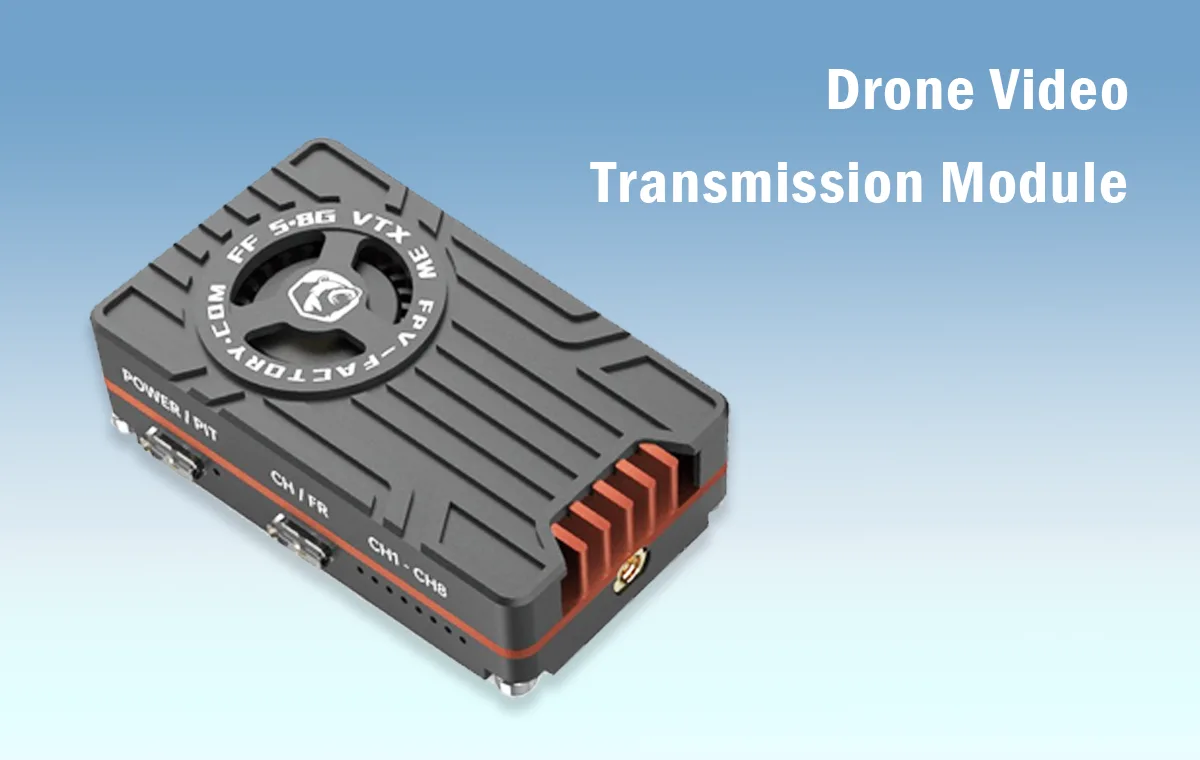
Why Video Transmission Quality Determines Drone Mission Success
In any drone system—whether FPV, surveillance, or AI reconnaissance—the video transmission module is the operator's window to the sky.
Yet over 40% of in-field drone failures in surveillance and inspection tasks are caused by signal dropout, video jitter, or RF interference (source: 2024 Commercial UAV Systems Report).
Even a 100ms delay at 60 fps can result in missed targets or pilot overcorrection in high-speed FPV racing.
A professional-grade drone must have a video TX system that is:
- Low-latency (ideally <50ms for FPV)
- Interference-resistant (especially around motors, ESCs, GPS)
- HD-capable (720p–1080p with adaptive encoding)
- Compatible with ground station or goggles (HDZero, DJI O3, analog)
System Architecture of a Drone Video Transmission Module
| Component | Function | Design Note |
|---|---|---|
| Camera Interface | Accepts digital video input (MIPI, HDMI) | High-speed impedance matched layout |
| Encoder | Compresses signal using H.264/H.265 | Thermal relief & clock jitter control essential |
| RF Front End (TX) | Transmits signal over 5.8GHz / 2.4GHz | Shielding, harmonic suppression |
| Power Management | 3.3V, 5V, 12V rails | Use LC filtering + TVS diodes |
| Antenna Port | Connects to linear/circular polarized antennas | 50Ω matching trace, grounded edge routing |
⚠️ Don't overlook the switching noise from onboard DC-DC converters near the encoder. It's a frequent source of ghosting artifacts.
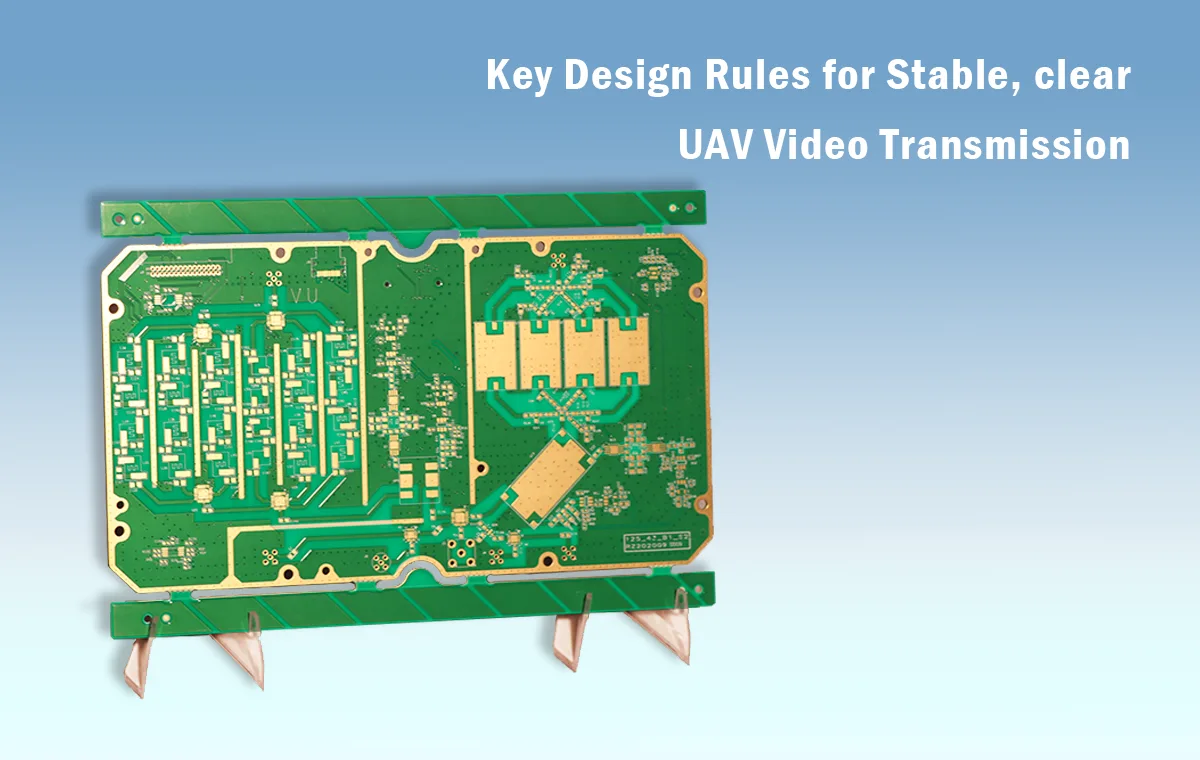
Key Design Rules for Stable, Clear UAV Video Transmission
1. High-Speed Differential Routing (MIPI/HDMI)
- Controlled 100Ω differential impedance
- Avoid stub length >3mm
- Matched length within ±10mil
2. EMI Shielding and RF Ground Strategy
- Use solid ground under RF components
- Add stitching vias every 2cm along video path
- Metal shields over RF + encoder zones
- Keep >10mm spacing from ESCs & motors
3. Thermal Management
- Copper pour under encoder IC
- Add 0.3mm thermal vias (0.6mm pad) to GND
- For 4K encoders, add forced-air heatsink zones
4. Power Filtering
- PI filters (10µF + 0.1µF + ferrite) on each voltage rail
- Use TVS diodes (e.g., PESD5V0S1UL) for ESD protection at antenna port
Applications by Industry & Recommended Specs
| Application | Key Requirements | Recommendation |
|---|---|---|
| FPV Racing Drones | Ultra-low latency, minimal jitter | Analog or DJI O3 / HDZero with 50ms encoder |
| Industrial Inspection | 1080p clarity, EMI-resistant | H.264 encoder + 5.8GHz RF with conformal coating |
| Agricultural UAVs | Long range, stable under vibration | 2.4GHz module + screw-mounted connectors |
| Security & Surveillance | Real-time stream with GPS overlay | RTMP/UDP output + encrypted RF module |
| AI Drones (CV / ML) | Low-loss feed for object detection | RAW MIPI video + buffer pre-processor |
Common Mistakes That Degrade UAV Video Quality
| Mistake | Impact | Solution |
|---|---|---|
| Shared ground plane with ESCs | EMI noise, dropouts | Use split planes, single-point star grounding |
| No thermal relief for encoder | Overheating → black screen | Add thermal vias + heatsinks |
| 90° bends in high-speed video lines | Signal reflections | Use 45° turns or curved routes |
| Long antenna trace w/o matching | Lossy signal | Ensure 50Ω impedance + grounded edge coupling |
| Switching regulator too close to RF | Image ghosting | Shield + distance >20mm from encoder path |
Why Work with Rich Full Joy on Video TX Module Design & Assembly
- ✅ Over 20 Years in High-Frequency PCB Design
- ✅ Experience in RF TX Modules up to 6GHz
- ✅ Full DFM/DFT Support for UAV Video Boards
- ✅ Shielding, Potting, Conformal Coating Capable
- ✅ Quick-Turn Prototyping + Mass PCBA for Drone OEMs
📌 Whether you need a compact analog TX board for racing drones or a digital 1080p encoder + RF stack for autonomous surveillance, we design, manufacture, and assemble it — all in-house.