
SMT PCB Assembly Common Issues & Solutions – Troubleshooting Guide for High-Quality Manufacturing
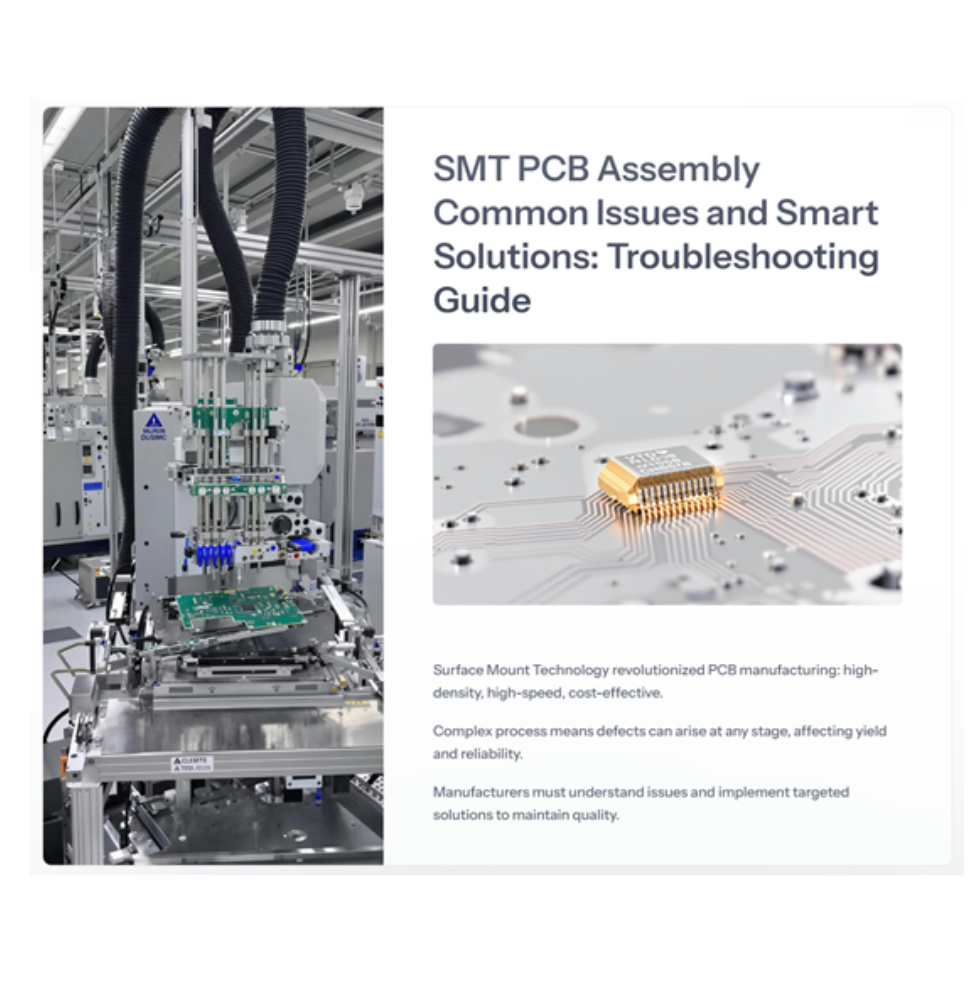
SMT PCB Assembly Common Issues and Smart Solutions: Troubleshooting Guide

- Introduction: Why Troubleshooting SMT PCB Assembly is Critical1.
Surface Mount Technology (SMT) has revolutionized PCB manufacturing by enabling high-density, high-speed, and cost-effective production. However, due to the complexity of the process, defects can arise at various stages, affecting yield rates, reliability, and performance.To ensure high-quality SMT PCB assembly, manufacturers must understand common issues and implement targeted solutions to eliminate defects.
- Common SMT PCB Assembly Issues and Their Solutions
(1) Solder Bridging – The Root Cause of Short Circuits
Problem:
- Excess solder between adjacent pads, causing electrical shortsCommon in fine-pitch components like BGA, QFN, and QFP
Causes::
❌ Excessive solder paste application
❌ Incorrect stencil design (wrong aperture size or thickness)
❌ PCB misalignment during reflow soldering

Solutions:
✅ Optimize stencil design (reduce paste volume in fine-pitch areas)
✅ Adjust squeegee pressure & angle to ensure uniform paste application
✅ Use AOI (Automated Optical Inspection) to detect solder bridges early
✅ Modify reflow temperature profile to prevent overheating
(2) Tombstoning – The Mysterious "Standing" Component
Problem:
- One end of a small passive component (e.g., resistors, capacitors)lifts off the PCB during reflow, resembling a tombstone
Causes:
❌ Uneven heating during reflow soldering
❌ Imbalanced solder paste volume on both pads
❌ High surface tension of molten solder pulling the component upward
Solutions:
✅ Ensure symmetrical solder paste deposition for balanced wetting
✅ Use gradual temperature ramp-up in the reflow profile to avoid thermal shock
✅ Optimize pad design to maintain even heat distribution
(3) Cold Solder Joints – Weak Connections That Lead to Failures
Problem:
- Dull, grainy, or incomplete solder joints that cause unreliable connections
Causes:
❌ Insufficient heat during reflow soldering
❌ Poor solder paste quality or contamination
❌ Oxidized component leads or PCB pads
Solutions:
✅ Ensure optimal reflow temperature profile to achieve complete solder melting
✅ Use high-quality solder paste with controlled flux activity
✅ Store PCBs and components in humidity-controlled environments to prevent oxidation
(4) Component Misalignment – A Hidden Threat to Circuit Functionality
Problem:
- Components shift during reflow, leading to misaligned pads or improper electrical contact
Causes:
❌ Excessive placement pressure from the pick-and-place machine
❌ Low viscosity solder paste causing component drift
❌ Vibrations or airflow disturbances in the reflow oven
Solutions:
✅ Fine-tune pick-and-place machine settings for precise component placement
✅ Use high-viscosity solder paste to improve adhesion before reflow
✅ Reduce vibrations and airflow inconsistencies in the reflow chamber
(5) Solder Balling – Tiny Unwanted Solder Particles
Problem:
- Small solder balls scattered around solder joints, which can cause electrical shorts
Causes:
❌ Rapid evaporation of solder flux during reflow
❌ Excessive reflow temperature or overly aggressive preheating
❌ Contaminated PCB surface
Solutions:
✅ Use optimized reflow profiles with controlled preheating and ramp-up rates
✅ Improve PCB cleaning processes to remove contaminants before soldering✅ Select low-residue, high-quality solder paste to minimize flux splatter
(6) Voids in Solder Joints – The Hidden Reliability Killer
Problem:
- Small gaps within solder joints, leading to weakened electrical and thermal conductivity
Causes:
❌ Trapped gas from solder paste volatiles
❌ Poor outgassing during reflow
❌ Incorrect pad design in high-power applications
Solutions:
✅ Use vacuum reflow soldering to reduce void formation
✅ Optimize stencil design and paste application for better solder flow
✅ Employ X-ray inspection to detect voids in BGA and power modules
(7) Open Circuits – The Silent PCB Failure
Problem:
- No electrical connection between component leads and PCB pads, leading to circuit failures
Causes:
❌ Insufficient solder paste application
❌ Oxidized component leads preventing solder wetting
❌ Poor component placement or mechanical stress during handling
Solutions:
✅ Ensure accurate solder paste volume through SPI (Solder Paste Inspection)
✅ Use fresh, oxidation-free components for better solder adhesion
✅ Perform ICT (In-Circuit Testing) to verify electrical connectivity
- Best Practices for SMT PCB Assembly Success
To minimize defects and optimize SMT assembly quality, follow these key best practices:
(1) Implement a Robust Inspection Process
🔹 SPI (Solder Paste Inspection) – Ensures correct paste application🔹
🔹 AOI (Automated Optical Inspection) – Detects component placement and soldering defects
🔹 X-Ray Inspection – Identifies hidden voids and BGA defects🔹
🔹 ICT (In-Circuit Testing) – Verifies electrical performance🔹
(2) Optimize Reflow Soldering Profiles
📌 Use gradual ramp-up and controlled cooling to prevent thermal stress and soldering issues.📌
(3) Use High-Quality Materials
📌 Select reliable PCB substrates, premium solder paste, and precise stencils to enhance process stability.📌
(4) Maintain a Clean and Controlled Environment
📌 Control humidity, temperature, and contamination levels to avoid oxidation and soldering inconsistencies.📌
- The Future of SMT PCB Assembly: AI-Driven Quality Control
With advancements in AI-powered inspection and smart manufacturing, future SMT assembly lines will integrate:
✅ AI-based defect prediction for proactive quality control
✅ Automated process optimization using real-time data
✅ Machine learning for adaptive soldering techniques
These innovations will drive zero-defect production and boost manufacturing efficiency in the electronics industry.
Elevate Your SMT PCB Assembly Quality with Proven Solutions!
Understanding common SMT PCB assembly challenges and applying the right solutions ensures high yield, reliable performance, and cost-effective production.
With 20 years of experience in PCB manufacturing and assembly, Rich Full Joy provides cutting-edge solutions for defect-free SMT PCB production!💡 Rich Full Joy
📞 Contact us today to optimize your SMT PCB assembly process!